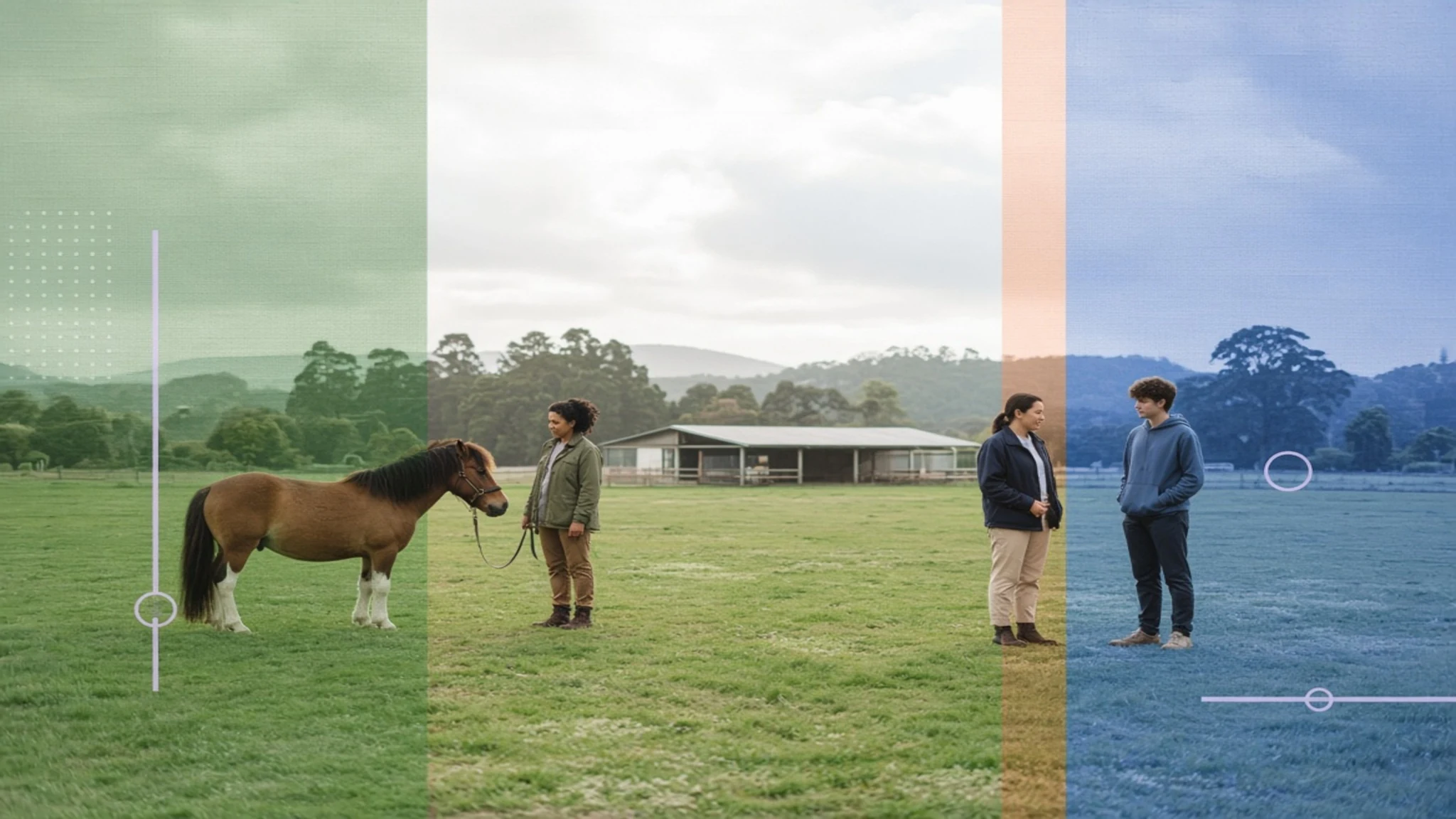
The central seam makes responsibility visible. One side describes observable context; the other side asks what people should clarify, change or take to an authorised real person.
Four example joins
Observe without overclaiming
Whole setting
Pony context
Take in the full body, handler, surface, weather, nearby activity and available exit.
People response
Describe only what is visible and ask the competent handler whether the picture differs from what they expect.
A cropped moment never tells the whole story.
Response to approach
Pony context
A pony may turn, pause, step away or remain still as a person approaches.
People response
Slow down and increase distance. Let the handler decide whether another person should enter the space.
Respecting distance is always available.
Changed surface
Pony context
Moisture, hardness, clutter or uneven ground can alter the context for every pony and person.
People response
Inspect the real area and follow the organiser's decision to move, modify, postpone or stop.
The app cannot approve footing.
Ending early
Pony context
The pony, participant, equipment or environment no longer supports the plan.
People response
Close out calmly, keep handling responsibility continuous and use official systems for any required record.
Ending early can be the responsible outcome.
Language boundary
Visible is not diagnosed
Twofold Rally does not declare that an ear, gaze, posture, movement or change proves fear, pain, calm, illness or intent. Sudden, severe, persistent or unexplained concern belongs with the responsible handler and an appropriate qualified professional.